CRG-SFOM-ENERGY-REALIGNMENT BRIEF — 0426/1
05/04/26 09:32
CRG-SFOM-ENERGY-REALIGNMENT BRIEF — 0426/1
Europe’s Energy Geometry Under Strategic Compression
Classification: Post-Alignment Correction Model
Division: Strategic Forecasting & Outcome Modeling (SFOM)
Timestamp: April 2026
Executive Summary
Europe is currently positioned inside a dual-conflict pressure system where both active war theatres generate net-negative economic and structural outcomes for the EU and NATO bloc.
The Russia–Ukraine conflict restricts direct access to low-cost energy inputs.
The Iran–USA/Israel conflict destabilizes alternative supply corridors and increases dependency on distant providers.
The combined effect is energy price elevation, industrial contraction, and strategic dependency realignment.
Within this configuration, policy driven by narrative alignment rather than material optimization is producing cumulative systemic drag.
Current Escalation Structure
Russia–Ukraine Conflict
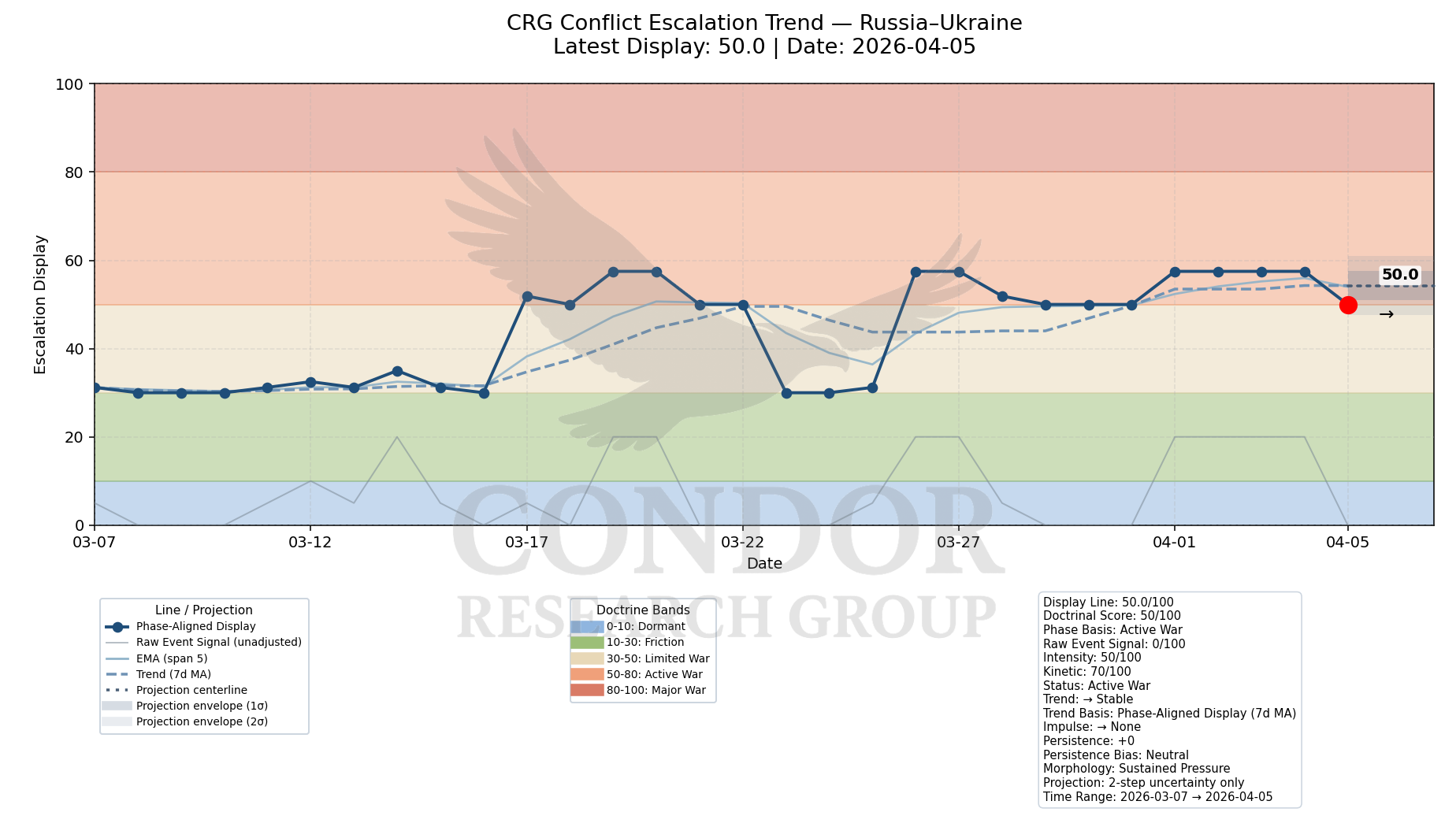
- Display Level: 50 / 100
- Phase: Active War
- Trend: Stable
- Morphology: Sustained pressure
The conflict has stabilized at a persistent mid-intensity plateau, indicating neither resolution nor escalation dominance.
This creates a long-duration constraint environment rather than a decisive outcome trajectory.
Iran–USA/Israel Conflict
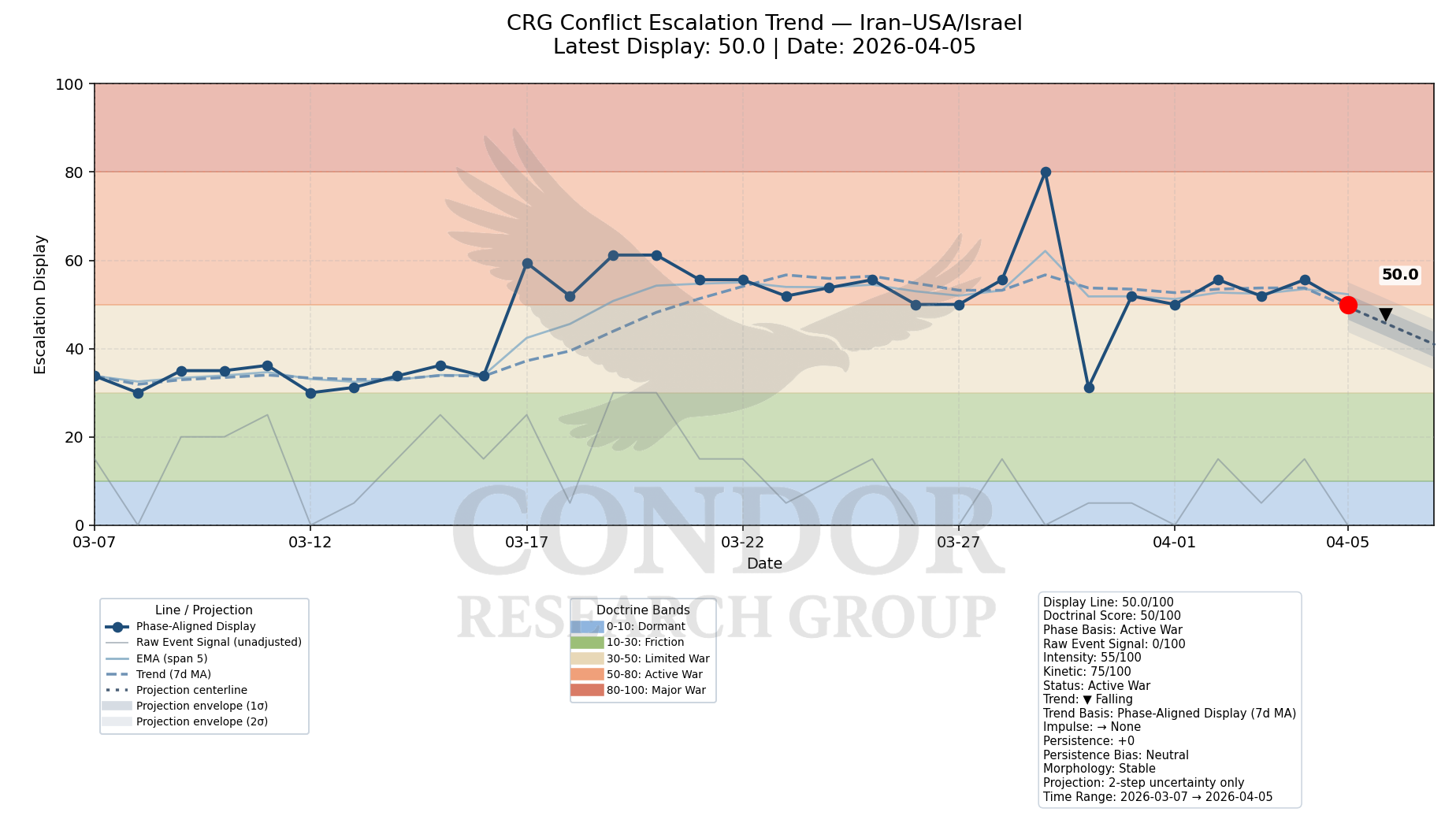
- Display Level: 50 / 100
- Phase: Active War
- Trend: Falling
- Morphology: Stable
Despite volatility spikes, the system is currently normalizing downward from higher peaks, but remains structurally within Active War conditions.
This conflict primarily affects global energy routing, insurance premiums, and supply certainty, rather than direct European territory.
Structural Impact on Europe
1. Energy Input Disruption
Europe’s industrial base is dependent on:
- Natural gas → fertilizer production
- Oil derivatives → transport, aviation, logistics
- Stable pricing → manufacturing competitiveness
The removal of Russian pipeline gas has resulted in:
- Substitution with higher-cost LNG
- Increased exposure to maritime chokepoints
- Price volatility tied to external conflicts
Simultaneously, instability in the Middle East:
- Raises insurance and transit costs
- Reduces supply predictability
- Amplifies pricing pressure across all energy classes
Result:
Europe operates under dual constraint — reduced supply certainty and increased cost basis.
2. Strategic Dependency Shift
The current configuration produces:
- Increased reliance on transatlantic energy flows
- Reduced autonomy in pricing and sourcing decisions
- Alignment pressure within NATO frameworks overriding economic optimization
This introduces a dependency gradient, where:
- Supply security becomes politically mediated
- Pricing becomes externally influenced
- Strategic optionality is reduced
3. Industrial Degradation Loop
Higher energy prices translate into:
- Reduced fertilizer output → agricultural downstream effects
- Increased manufacturing costs → relocation incentives
- Declining export competitiveness
Over time, this creates:
- Deindustrialization pressure
- Capital flight toward lower-cost jurisdictions
- Structural weakening of internal EU production capacity
Narrative vs Material Alignment
Current European positioning is partially sustained by narrative cohesion mechanisms, including:
- Moral framing of conflicts
- Alliance signaling
- Political consistency requirements
However, within CRG modeling, narrative alignment does not substitute for material equilibrium.
Observed effect:
- Policy persistence despite negative economic feedback
- Delay in corrective action
- Accumulation of systemic inefficiencies
This results in what can be described as:
Narrative lock-in under deteriorating economic conditions
Energy Reconfiguration Pathways
From a purely structural perspective, Europe has three options:
1. Maintain current trajectory
- Continued high-cost imports
- Long-term industrial erosion
2. Diversify externally
- Limited scalability
- Continued exposure to instability zones
3. Reintegrate proximate supply (Russia)
- Lower transport cost
- High-volume stability
- Reduced exposure to maritime disruption
Only the third option resolves:
- Price stability
- Supply continuity
- Industrial recovery potential
Denmark as a Structural Node
Within this framework, Denmark occupies a geographic and infrastructural leverage position:
- Proximity to Baltic energy corridors
- Existing pipeline architecture (Nord Stream network remains partially viable)
- Political flexibility relative to larger EU states
A redirection or partial restoration pathway via Danish routing would:
- Bypass stalled German decision cycles
- Re-establish controlled flow into Northern Europe
- Provide early mover advantage in energy normalization
Strategic Interpretation
The coexistence of:
- A stabilized Eastern European conflict (Russia–Ukraine)
- A volatile but contained Middle Eastern conflict (Iran–USA/Israel)
produces a combined pressure field where:
Europe absorbs cost, while external actors retain optionality
Neither conflict, in its current form, delivers:
- Territorial benefit to Europe
- Economic gain
- Strategic autonomy
Instead, both function as constraint amplifiers on European systems.
Conclusion
From a system-level perspective:
- The continuation of both conflicts maintains elevated pressure on Europe
- The absence of Russian energy integration sustains structural inefficiency
- The instability of Middle Eastern supply compounds dependency
The optimal stabilization pathway involves:
- De-escalation in Ukraine sufficient to enable trade normalization
- Re-entry into proximate energy supply systems
- Reduction of exposure to distant, high-risk supply chains
This is not a political recommendation, but a material equilibrium observation.
Document: CRG-SFOM-ENERGY-REALIGNMENT BRIEF — 0426/1
Classification: Post-Alignment Correction Model
Revision Status: Final — Approved for internal CRG circulation, external academic reference, and web publication
Authorized By: Condor Research Group (CRG)
Division: Strategic Forecasting & Outcome Modeling (SFOM)
Original Draft Date: April 2026
Release Date: 05 April 2026
Version: CRG-INT-VER-A1-FINAL
Publication Note: Web release delayed; layout modified from raw analytical format
Europe’s Energy Geometry Under Strategic Compression
Classification: Post-Alignment Correction Model
Division: Strategic Forecasting & Outcome Modeling (SFOM)
Timestamp: April 2026
Executive Summary
Europe is currently positioned inside a dual-conflict pressure system where both active war theatres generate net-negative economic and structural outcomes for the EU and NATO bloc.
The Russia–Ukraine conflict restricts direct access to low-cost energy inputs.
The Iran–USA/Israel conflict destabilizes alternative supply corridors and increases dependency on distant providers.
The combined effect is energy price elevation, industrial contraction, and strategic dependency realignment.
Within this configuration, policy driven by narrative alignment rather than material optimization is producing cumulative systemic drag.
Current Escalation Structure
Russia–Ukraine Conflict
- Display Level: 50 / 100
- Phase: Active War
- Trend: Stable
- Morphology: Sustained pressure
The conflict has stabilized at a persistent mid-intensity plateau, indicating neither resolution nor escalation dominance.
This creates a long-duration constraint environment rather than a decisive outcome trajectory.
Iran–USA/Israel Conflict
- Display Level: 50 / 100
- Phase: Active War
- Trend: Falling
- Morphology: Stable
Despite volatility spikes, the system is currently normalizing downward from higher peaks, but remains structurally within Active War conditions.
This conflict primarily affects global energy routing, insurance premiums, and supply certainty, rather than direct European territory.
Structural Impact on Europe
1. Energy Input Disruption
Europe’s industrial base is dependent on:
- Natural gas → fertilizer production
- Oil derivatives → transport, aviation, logistics
- Stable pricing → manufacturing competitiveness
The removal of Russian pipeline gas has resulted in:
- Substitution with higher-cost LNG
- Increased exposure to maritime chokepoints
- Price volatility tied to external conflicts
Simultaneously, instability in the Middle East:
- Raises insurance and transit costs
- Reduces supply predictability
- Amplifies pricing pressure across all energy classes
Result:
Europe operates under dual constraint — reduced supply certainty and increased cost basis.
2. Strategic Dependency Shift
The current configuration produces:
- Increased reliance on transatlantic energy flows
- Reduced autonomy in pricing and sourcing decisions
- Alignment pressure within NATO frameworks overriding economic optimization
This introduces a dependency gradient, where:
- Supply security becomes politically mediated
- Pricing becomes externally influenced
- Strategic optionality is reduced
3. Industrial Degradation Loop
Higher energy prices translate into:
- Reduced fertilizer output → agricultural downstream effects
- Increased manufacturing costs → relocation incentives
- Declining export competitiveness
Over time, this creates:
- Deindustrialization pressure
- Capital flight toward lower-cost jurisdictions
- Structural weakening of internal EU production capacity
Narrative vs Material Alignment
Current European positioning is partially sustained by narrative cohesion mechanisms, including:
- Moral framing of conflicts
- Alliance signaling
- Political consistency requirements
However, within CRG modeling, narrative alignment does not substitute for material equilibrium.
Observed effect:
- Policy persistence despite negative economic feedback
- Delay in corrective action
- Accumulation of systemic inefficiencies
This results in what can be described as:
Narrative lock-in under deteriorating economic conditions
Energy Reconfiguration Pathways
From a purely structural perspective, Europe has three options:
1. Maintain current trajectory
- Continued high-cost imports
- Long-term industrial erosion
2. Diversify externally
- Limited scalability
- Continued exposure to instability zones
3. Reintegrate proximate supply (Russia)
- Lower transport cost
- High-volume stability
- Reduced exposure to maritime disruption
Only the third option resolves:
- Price stability
- Supply continuity
- Industrial recovery potential
Denmark as a Structural Node
Within this framework, Denmark occupies a geographic and infrastructural leverage position:
- Proximity to Baltic energy corridors
- Existing pipeline architecture (Nord Stream network remains partially viable)
- Political flexibility relative to larger EU states
A redirection or partial restoration pathway via Danish routing would:
- Bypass stalled German decision cycles
- Re-establish controlled flow into Northern Europe
- Provide early mover advantage in energy normalization
Strategic Interpretation
The coexistence of:
- A stabilized Eastern European conflict (Russia–Ukraine)
- A volatile but contained Middle Eastern conflict (Iran–USA/Israel)
produces a combined pressure field where:
Europe absorbs cost, while external actors retain optionality
Neither conflict, in its current form, delivers:
- Territorial benefit to Europe
- Economic gain
- Strategic autonomy
Instead, both function as constraint amplifiers on European systems.
Conclusion
From a system-level perspective:
- The continuation of both conflicts maintains elevated pressure on Europe
- The absence of Russian energy integration sustains structural inefficiency
- The instability of Middle Eastern supply compounds dependency
The optimal stabilization pathway involves:
- De-escalation in Ukraine sufficient to enable trade normalization
- Re-entry into proximate energy supply systems
- Reduction of exposure to distant, high-risk supply chains
This is not a political recommendation, but a material equilibrium observation.
Document: CRG-SFOM-ENERGY-REALIGNMENT BRIEF — 0426/1
Classification: Post-Alignment Correction Model
Revision Status: Final — Approved for internal CRG circulation, external academic reference, and web publication
Authorized By: Condor Research Group (CRG)
Division: Strategic Forecasting & Outcome Modeling (SFOM)
Original Draft Date: April 2026
Release Date: 05 April 2026
Version: CRG-INT-VER-A1-FINAL
Publication Note: Web release delayed; layout modified from raw analytical format