CRG-IR-INT-0826/2: THE FRACTURED PLATEAU
19/08/26 11:21
CRG-IR-INT-0826/2
THE FRACTURED PLATEAU
Iran After Central Collapse: Territorial Control, Strategic Friction and the Limits of Partition
Condor Research Group (CRG)
Geopolitical & Strategic Intelligence Division
Date: 19 August 2026
Classification: UNCLASSIFIED // SCENARIO ANALYSIS
Confidence: Moderate
EXECUTIVE ASSESSMENT
A military defeat severe enough to destroy effective central authority in Iran would not necessarily produce the clean territorial partition often implied by maps of the country's ethnic geography.
Condor Research Group assesses that the more plausible consequence would be a prolonged competition between local autonomy, contested security zones, temporary foreign influence and the eventual reconstruction of an Iranian state. The constitutional form of that state — unitary, decentralized, federal or confederal — would remain uncertain.
This assessment is an excerpt from the full CRG report, The Fractured Plateau: A Strategic Scenario Analysis of the Territorial Fragmentation of Iran Following Military Defeat. The full study examines all 31 Iranian provinces, demographic and ethnic geography, energy and water infrastructure, nuclear and missile security, external powers, competing successor entities, and seven alternative post-collapse hypotheses.
The scenario is conditional. It does not assert that Iran will fragment, that partition is current policy, or that any foreign government intends to annex or divide Iranian territory.
THE CENTRAL PROBLEM
Iran can be divided on a map much more easily than it can be divided in reality. Ethnic populations overlap. Major cities are multi-ethnic. Oil and gas infrastructure crosses prospective political boundaries. Water systems connect provinces whose political interests might diverge after a collapse. Transport networks were constructed for a national economy rather than independent successor states.
The same is true of military and strategic infrastructure. Consequently, the collapse of central authority would create contested control rather than empty territory waiting to be divided among neighbouring states. The distinction is critical. Territorial control during a collapse is not the same thing as a durable international border.
THE PROVINCIAL CONTROL PROBLEM
CRG examined all 31 Iranian provinces individually rather than beginning with a predetermined partition map.
Each province was assessed according to:
- likely post-collapse controller or security arrangement;
- probable political status;
- strategic importance;
- ethnic and demographic complications;
- energy, transport, water or military infrastructure; and
- confidence in the assessment.
The resulting matrix illustrates why a comprehensive partition is difficult to sustain.
The central plateau — including Tehran, Isfahan, Fars, Qom, Yazd and much of the surrounding interior; remains the natural nucleus of a reconstituted Iranian state.
The northwest presents a different problem. East Azerbaijan, Ardabil and Zanjan could support substantial Azerbaijani autonomy, but this does not automatically imply incorporation into the Republic of Azerbaijan. West Azerbaijan is particularly difficult because Azerbaijani and Kurdish population zones overlap.
The Kurdish west presents a similar problem. Kurdistan, Kermanshah and parts of Ilam could develop autonomous or contested political structures following the collapse of central authority. Yet an Iranian Kurdish entity would face opposition from neighbouring states concerned about the consequences for their own Kurdish populations.
Khuzestan is strategically exceptional. Its oil fields, refineries, pipelines, Arab population, access to the Gulf and proximity to Iraq make it simultaneously one of the most valuable and one of the most difficult provinces for any successor government to lose.
Hormozgan and Bushehr introduce another dimension. Control of the Strait of Hormuz, Bandar Abbas, Gulf islands, export infrastructure and the Bushehr nuclear facility would give external powers powerful incentives to intervene in the security environment without necessarily seeking permanent sovereignty over Iranian territory.
Sistan and Baluchestan represents yet another form of fragmentation risk: weak central control, cross-border ethnic connections, sparse geography and proximity to Pakistan and Afghanistan could create a security zone without producing a viable independent state.
The result is not a neat partition. It is a mosaic of retained territory, negotiated autonomy, contested zones, temporary security arrangements and regions whose eventual political status would depend upon whether a new Iranian centre could reconstruct effective authority.
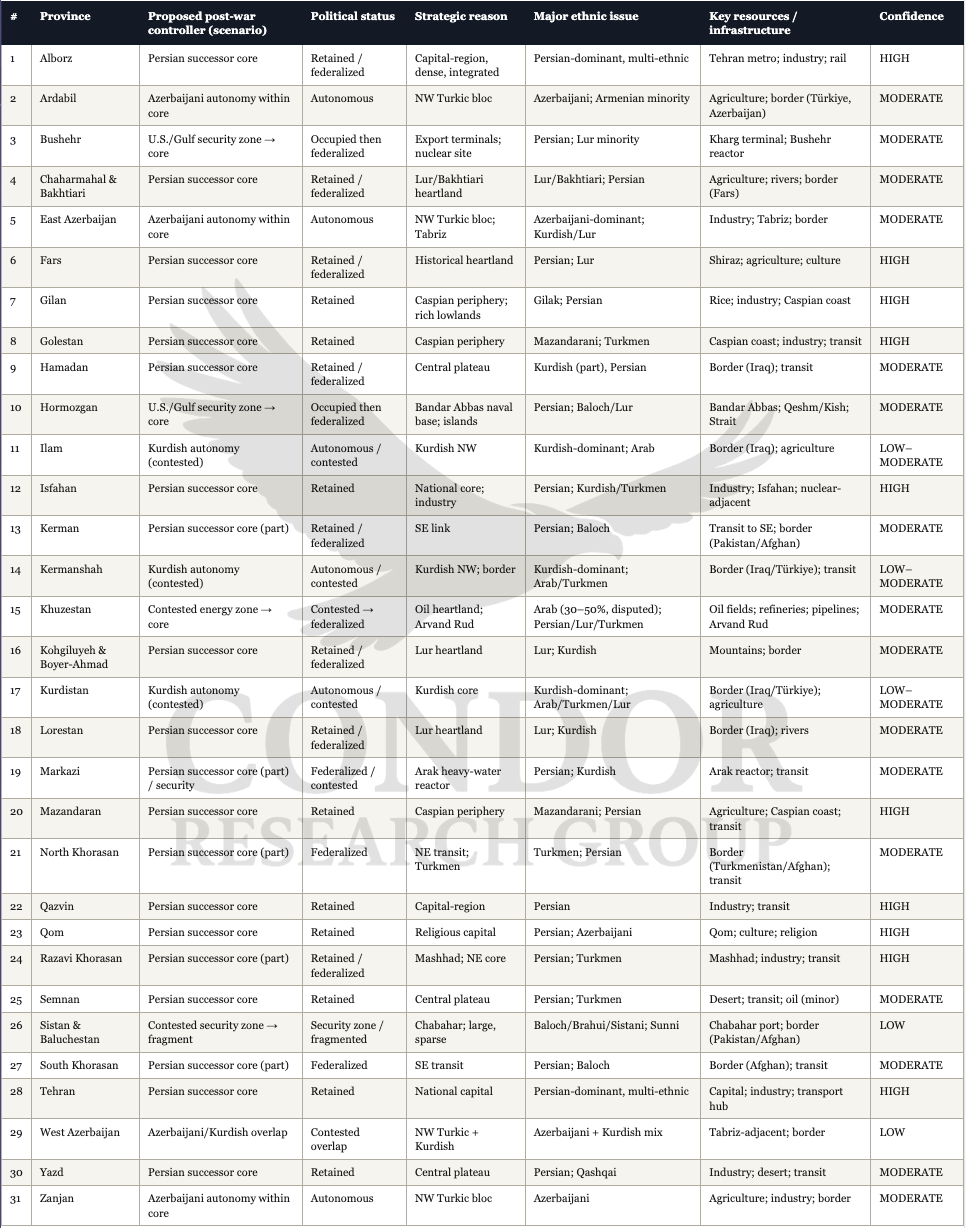
Figure 1. CRG 31-Province Post-War Control Matrix — conditional scenario assessment, not a prediction of territorial partition.
WHAT THE MATRIX SHOWS
The matrix produces several important conclusions.
First, the Iranian interior remains geographically and institutionally difficult to fragment. A successor authority controlling Tehran and the central plateau would inherit the country's largest concentration of population, administration, transport and industrial capacity.
Second, ethnic concentration does not translate automatically into viable sovereignty. Kurdish and Azerbaijani autonomy are considerably easier to imagine than internationally recognized Kurdish or Azerbaijani successor states.
Third, the most strategically valuable peripheral territories are precisely those most likely to attract competing interests. Khuzestan, Hormozgan and Bushehr cannot be assessed solely through ethnicity because energy infrastructure, maritime access, nuclear security and external military interests are at least as important.
Fourth, several possible post-collapse zones would initially represent security conditions rather than states. Foreign-controlled installations, contested oil regions, autonomous administrations and militia territories should not be mistaken for durable borders.
Finally, the matrix demonstrates the central paradox of Iranian fragmentation: The greater the fragmentation, the stronger the incentives become for somebody to reconstruct a centre.
PARTITION VERSUS RECONSTITUTION
The full CRG assessment tests seven competing hypotheses rather than assuming partition as the outcome. The lowest-probability pathway is a durable comprehensive ethnic partition of Iran into multiple internationally recognized states. More plausible intermediate outcomes include militia fragmentation, temporary foreign security or protectorate zones, and attempts by a Persian successor core to restore control. The two leading long-term hypotheses in the full assessment are instead forms of Iranian reconstitution:
H6 — a federal or confederal Iranian successor in which significant regional autonomy becomes institutionalized; and
H7 — regime replacement without substantial territorial fragmentation, in which a new central government restores effective control while retaining a more unitary political structure.
CRG currently assigns equal conditional weight to these two pathways. The distinction concerns primarily the political structure of the reconstructed state rather than whether Iran simply disappears from the map.
These probabilities are analyst-calibrated conditional estimates, not statistical forecasts. Their purpose is to force explicit comparison between competing outcomes rather than imply measurement precision.
THE LIMITS OF ETHNIC MAPS
One of the strongest findings of the full study is that ethnic maps are poor substitutes for political analysis.
A coloured region labelled "Kurdish," "Azerbaijani," "Arab" or "Baloch" can conceal mixed cities, minority populations, competing political preferences, economic dependence on neighbouring provinces and infrastructure that cannot readily be separated. Nor does ethnic identity establish a preference for secession. Survey evidence examined in the full report weakens both the comprehensive-partition thesis and the assumption that federalization commands broad national support. This is one reason the final assessment gives regime replacement within a reconstituted Iranian state the same analytical weight as a federal or confederal successor. The decisive variable after central collapse may therefore be less the location of ethnic populations than the ability of competing authorities to provide security, preserve infrastructure, maintain economic exchange and obtain political legitimacy.
EXTERNAL POWERS
Iran's neighbours would have strong interests in the outcome of a collapse, but influence should not be confused with annexation.
Türkiye would be particularly sensitive to the emergence of a contiguous Kurdish political corridor.
Azerbaijan would have political and cultural interests in Iranian Azerbaijani regions but would also face substantial strategic risks from direct territorial expansion.
Iraq would be exposed simultaneously to Kurdish developments and instability surrounding Khuzestan and the Shatt al-Arab/Arvand Rud region.
Pakistan would have powerful incentives to prevent instability in Iranian Baluchestan from spreading across the border.
Gulf states would be concerned with energy infrastructure, maritime security and Iranian power on the northern Gulf coast.
The United States and other external powers would have strong interests in nuclear security, freedom of navigation and preventing uncontrolled proliferation.
These interests could produce temporary zones of influence or security arrangements. They do not by themselves establish a durable partition.
THE STRATEGIC JUDGMENT
The collapse of Tehran's effective authority would not answer the question of who governs Iran.
It would begin that question.
CRG assesses with moderate confidence that a clean and durable comprehensive partition would be substantially less likely than some form of Iranian political reconstitution.
The intervening period, however, could be violent and territorially ambiguous. Kurdish autonomy, Azerbaijani autonomy, a contested Khuzestan energy zone, instability in Sistan and Baluchestan, and external security involvement along the Gulf could coexist temporarily without becoming internationally recognized successor states. The central analytical distinction is therefore between fragmentation as a process and partition as an end state. Iran could experience the former without ultimately producing the latter.
ABOUT THE FULL REPORT
This briefing is an excerpt derived from the full Condor Research Group report:
The Fractured Plateau: A Strategic Scenario Analysis of the Territorial Fragmentation of Iran Following Military Defeat.
The full CRG assessment contains the complete 31-province analysis, demographic and ethnic baseline, energy and water geography, assessment of potential territorial centres of power, external-actor analysis, nuclear and strategic-weapons considerations, a province-by-province Control Matrix, seven competing hypotheses (H1–H7), indicators and warning signposts, a ten-year scenario assessment, source-hardening audit and methodological limitations.
The full report was subjected to adversarial review and source hardening before final publication. Several original propositions were modified where the evidence did not support them, including the initial assumption that federalization represented the dominant popular alternative to the existing Iranian political system.
DOCUMENT INFORMATION
Document: CRG-IR-INT-0826/2: The Fractured Plateau – Iran After Central Collapse: Territorial Control, Strategic Friction and the Limits of Partition
Classification: Strategic Intelligence Assessment (Scenario Analysis)
Distribution: Public Release
Revision Status: Final — Approved for internal CRG circulation, external academic reference, and web publication
Authorized By: Condor Research Group (CRG)
Division: Geopolitical & Strategic Intelligence Division
Original Draft Date: August 2026
Release Date: 19 August 2026
Version: CRG-INT-VER-A1-FINAL
Keywords: Iran, Territorial Fragmentation, State Collapse, Federalization, Regime Change, Iranian Kurds, Iranian Azerbaijan, Khuzestan, Sistan and Baluchestan, Persian Gulf, Strait of Hormuz, United States, Türkiye, Azerbaijan, Iraq, Pakistan, Strategic Scenario Analysis, Geopolitics, Post-War Iran
Source Report: The Fractured Plateau: A Strategic Scenario Analysis of the Territorial Fragmentation of Iran Following Military Defeat
Publication Note: Published on the Condor Research Group website as part of the CRG Strategic Intelligence Assessment series. This briefing is an excerpt from a larger CRG scenario study and presents a conditional analysis of potential territorial and political outcomes following the collapse of effective central authority in Iran. It does not assert that Iran will be partitioned, that partition is probable, or that the United States or any other state intends to partition Iranian territory.
THE FRACTURED PLATEAU
Iran After Central Collapse: Territorial Control, Strategic Friction and the Limits of Partition
Condor Research Group (CRG)
Geopolitical & Strategic Intelligence Division
Date: 19 August 2026
Classification: UNCLASSIFIED // SCENARIO ANALYSIS
Confidence: Moderate
EXECUTIVE ASSESSMENT
A military defeat severe enough to destroy effective central authority in Iran would not necessarily produce the clean territorial partition often implied by maps of the country's ethnic geography.
Condor Research Group assesses that the more plausible consequence would be a prolonged competition between local autonomy, contested security zones, temporary foreign influence and the eventual reconstruction of an Iranian state. The constitutional form of that state — unitary, decentralized, federal or confederal — would remain uncertain.
This assessment is an excerpt from the full CRG report, The Fractured Plateau: A Strategic Scenario Analysis of the Territorial Fragmentation of Iran Following Military Defeat. The full study examines all 31 Iranian provinces, demographic and ethnic geography, energy and water infrastructure, nuclear and missile security, external powers, competing successor entities, and seven alternative post-collapse hypotheses.
The scenario is conditional. It does not assert that Iran will fragment, that partition is current policy, or that any foreign government intends to annex or divide Iranian territory.
THE CENTRAL PROBLEM
Iran can be divided on a map much more easily than it can be divided in reality. Ethnic populations overlap. Major cities are multi-ethnic. Oil and gas infrastructure crosses prospective political boundaries. Water systems connect provinces whose political interests might diverge after a collapse. Transport networks were constructed for a national economy rather than independent successor states.
The same is true of military and strategic infrastructure. Consequently, the collapse of central authority would create contested control rather than empty territory waiting to be divided among neighbouring states. The distinction is critical. Territorial control during a collapse is not the same thing as a durable international border.
THE PROVINCIAL CONTROL PROBLEM
CRG examined all 31 Iranian provinces individually rather than beginning with a predetermined partition map.
Each province was assessed according to:
- likely post-collapse controller or security arrangement;
- probable political status;
- strategic importance;
- ethnic and demographic complications;
- energy, transport, water or military infrastructure; and
- confidence in the assessment.
The resulting matrix illustrates why a comprehensive partition is difficult to sustain.
The central plateau — including Tehran, Isfahan, Fars, Qom, Yazd and much of the surrounding interior; remains the natural nucleus of a reconstituted Iranian state.
The northwest presents a different problem. East Azerbaijan, Ardabil and Zanjan could support substantial Azerbaijani autonomy, but this does not automatically imply incorporation into the Republic of Azerbaijan. West Azerbaijan is particularly difficult because Azerbaijani and Kurdish population zones overlap.
The Kurdish west presents a similar problem. Kurdistan, Kermanshah and parts of Ilam could develop autonomous or contested political structures following the collapse of central authority. Yet an Iranian Kurdish entity would face opposition from neighbouring states concerned about the consequences for their own Kurdish populations.
Khuzestan is strategically exceptional. Its oil fields, refineries, pipelines, Arab population, access to the Gulf and proximity to Iraq make it simultaneously one of the most valuable and one of the most difficult provinces for any successor government to lose.
Hormozgan and Bushehr introduce another dimension. Control of the Strait of Hormuz, Bandar Abbas, Gulf islands, export infrastructure and the Bushehr nuclear facility would give external powers powerful incentives to intervene in the security environment without necessarily seeking permanent sovereignty over Iranian territory.
Sistan and Baluchestan represents yet another form of fragmentation risk: weak central control, cross-border ethnic connections, sparse geography and proximity to Pakistan and Afghanistan could create a security zone without producing a viable independent state.
The result is not a neat partition. It is a mosaic of retained territory, negotiated autonomy, contested zones, temporary security arrangements and regions whose eventual political status would depend upon whether a new Iranian centre could reconstruct effective authority.
Figure 1. CRG 31-Province Post-War Control Matrix — conditional scenario assessment, not a prediction of territorial partition.
WHAT THE MATRIX SHOWS
The matrix produces several important conclusions.
First, the Iranian interior remains geographically and institutionally difficult to fragment. A successor authority controlling Tehran and the central plateau would inherit the country's largest concentration of population, administration, transport and industrial capacity.
Second, ethnic concentration does not translate automatically into viable sovereignty. Kurdish and Azerbaijani autonomy are considerably easier to imagine than internationally recognized Kurdish or Azerbaijani successor states.
Third, the most strategically valuable peripheral territories are precisely those most likely to attract competing interests. Khuzestan, Hormozgan and Bushehr cannot be assessed solely through ethnicity because energy infrastructure, maritime access, nuclear security and external military interests are at least as important.
Fourth, several possible post-collapse zones would initially represent security conditions rather than states. Foreign-controlled installations, contested oil regions, autonomous administrations and militia territories should not be mistaken for durable borders.
Finally, the matrix demonstrates the central paradox of Iranian fragmentation: The greater the fragmentation, the stronger the incentives become for somebody to reconstruct a centre.
PARTITION VERSUS RECONSTITUTION
The full CRG assessment tests seven competing hypotheses rather than assuming partition as the outcome. The lowest-probability pathway is a durable comprehensive ethnic partition of Iran into multiple internationally recognized states. More plausible intermediate outcomes include militia fragmentation, temporary foreign security or protectorate zones, and attempts by a Persian successor core to restore control. The two leading long-term hypotheses in the full assessment are instead forms of Iranian reconstitution:
H6 — a federal or confederal Iranian successor in which significant regional autonomy becomes institutionalized; and
H7 — regime replacement without substantial territorial fragmentation, in which a new central government restores effective control while retaining a more unitary political structure.
CRG currently assigns equal conditional weight to these two pathways. The distinction concerns primarily the political structure of the reconstructed state rather than whether Iran simply disappears from the map.
These probabilities are analyst-calibrated conditional estimates, not statistical forecasts. Their purpose is to force explicit comparison between competing outcomes rather than imply measurement precision.
THE LIMITS OF ETHNIC MAPS
One of the strongest findings of the full study is that ethnic maps are poor substitutes for political analysis.
A coloured region labelled "Kurdish," "Azerbaijani," "Arab" or "Baloch" can conceal mixed cities, minority populations, competing political preferences, economic dependence on neighbouring provinces and infrastructure that cannot readily be separated. Nor does ethnic identity establish a preference for secession. Survey evidence examined in the full report weakens both the comprehensive-partition thesis and the assumption that federalization commands broad national support. This is one reason the final assessment gives regime replacement within a reconstituted Iranian state the same analytical weight as a federal or confederal successor. The decisive variable after central collapse may therefore be less the location of ethnic populations than the ability of competing authorities to provide security, preserve infrastructure, maintain economic exchange and obtain political legitimacy.
EXTERNAL POWERS
Iran's neighbours would have strong interests in the outcome of a collapse, but influence should not be confused with annexation.
Türkiye would be particularly sensitive to the emergence of a contiguous Kurdish political corridor.
Azerbaijan would have political and cultural interests in Iranian Azerbaijani regions but would also face substantial strategic risks from direct territorial expansion.
Iraq would be exposed simultaneously to Kurdish developments and instability surrounding Khuzestan and the Shatt al-Arab/Arvand Rud region.
Pakistan would have powerful incentives to prevent instability in Iranian Baluchestan from spreading across the border.
Gulf states would be concerned with energy infrastructure, maritime security and Iranian power on the northern Gulf coast.
The United States and other external powers would have strong interests in nuclear security, freedom of navigation and preventing uncontrolled proliferation.
These interests could produce temporary zones of influence or security arrangements. They do not by themselves establish a durable partition.
THE STRATEGIC JUDGMENT
The collapse of Tehran's effective authority would not answer the question of who governs Iran.
It would begin that question.
CRG assesses with moderate confidence that a clean and durable comprehensive partition would be substantially less likely than some form of Iranian political reconstitution.
The intervening period, however, could be violent and territorially ambiguous. Kurdish autonomy, Azerbaijani autonomy, a contested Khuzestan energy zone, instability in Sistan and Baluchestan, and external security involvement along the Gulf could coexist temporarily without becoming internationally recognized successor states. The central analytical distinction is therefore between fragmentation as a process and partition as an end state. Iran could experience the former without ultimately producing the latter.
ABOUT THE FULL REPORT
This briefing is an excerpt derived from the full Condor Research Group report:
The Fractured Plateau: A Strategic Scenario Analysis of the Territorial Fragmentation of Iran Following Military Defeat.
The full CRG assessment contains the complete 31-province analysis, demographic and ethnic baseline, energy and water geography, assessment of potential territorial centres of power, external-actor analysis, nuclear and strategic-weapons considerations, a province-by-province Control Matrix, seven competing hypotheses (H1–H7), indicators and warning signposts, a ten-year scenario assessment, source-hardening audit and methodological limitations.
The full report was subjected to adversarial review and source hardening before final publication. Several original propositions were modified where the evidence did not support them, including the initial assumption that federalization represented the dominant popular alternative to the existing Iranian political system.
DOCUMENT INFORMATION
Document: CRG-IR-INT-0826/2: The Fractured Plateau – Iran After Central Collapse: Territorial Control, Strategic Friction and the Limits of Partition
Classification: Strategic Intelligence Assessment (Scenario Analysis)
Distribution: Public Release
Revision Status: Final — Approved for internal CRG circulation, external academic reference, and web publication
Authorized By: Condor Research Group (CRG)
Division: Geopolitical & Strategic Intelligence Division
Original Draft Date: August 2026
Release Date: 19 August 2026
Version: CRG-INT-VER-A1-FINAL
Keywords: Iran, Territorial Fragmentation, State Collapse, Federalization, Regime Change, Iranian Kurds, Iranian Azerbaijan, Khuzestan, Sistan and Baluchestan, Persian Gulf, Strait of Hormuz, United States, Türkiye, Azerbaijan, Iraq, Pakistan, Strategic Scenario Analysis, Geopolitics, Post-War Iran
Source Report: The Fractured Plateau: A Strategic Scenario Analysis of the Territorial Fragmentation of Iran Following Military Defeat
Publication Note: Published on the Condor Research Group website as part of the CRG Strategic Intelligence Assessment series. This briefing is an excerpt from a larger CRG scenario study and presents a conditional analysis of potential territorial and political outcomes following the collapse of effective central authority in Iran. It does not assert that Iran will be partitioned, that partition is probable, or that the United States or any other state intends to partition Iranian territory.