CRG-INT-0326/4: The War That Cannot End — Structural Lock-In Dynamics
Classification: System Persistence Analysis
Division: Strategic Forecasting & Outcome Modeling (SFOM)
Timestamp: March 2026
Executive Summary
The conflict between the U.S., Israel, and Iran is no longer governed by victory conditions.
It is governed by termination constraints.
At present:
No actor retains the structural ability to end the war without incurring unacceptable systemic cost.
This creates a lock-in state:
- escalation persists
- resolution remains inaccessible
- duration becomes the defining variable
Doctrinal Premise
Control does not require stability.
It requires predictability within instability.Wars end when at least one of the following conditions is met:
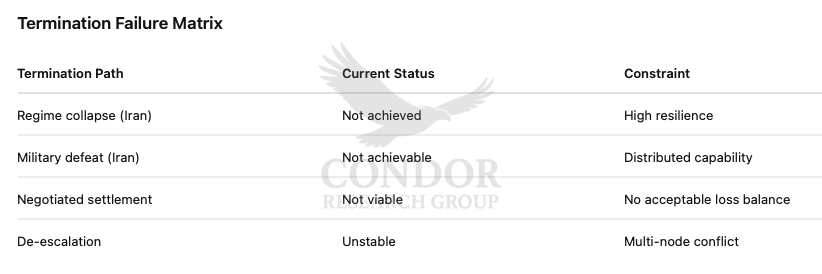
1. Decisive military defeat
2. Internal political collapse
3. Negotiated settlement with acceptable loss distribution
None of these conditions are currently viable.
CRG framing:
The war continues not because actors choose continuation,
but because termination pathways are structurally blocked
The Lock-In Mechanism
1. Escalation Without Decisive Capacity
- U.S./Israel retain strike superiority
- Iran retains resilience and distributed response capability
Result:
- Continuous escalation
- No decisive outcome
2. Political Cost Asymmetry
- U.S./Israel: high sensitivity to prolonged engagement
- Iran: higher tolerance for sustained pressure
Result:
- Time favors persistence, not resolution
3. Proxy System Entrenchment
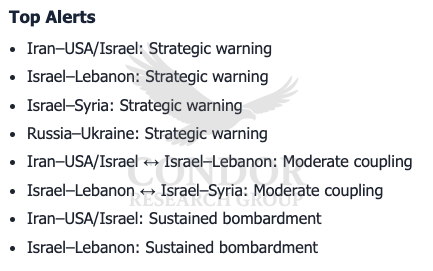
- Multiple active nodes (Lebanon, Iraq, Yemen, Syria)
- Independent escalation pathways
- Low-cost activation thresholds
Result:
Conflict becomes multi-origin and self-reinforcing
4. Global System Coupling
- Energy flows exposed (Hormuz dependency)
- Trade routes under pressure
- Financial and insurance systems reacting to instability
Result:
External systems begin to anchor the conflict in place.
External systems no longer react to the conflict.
They begin to depend on its persistence.
Threshold Transition
At a certain point, the conflict crosses a structural threshold:
Escalation → Self-sustaining system behavior
From this point:
The system does not require intentional escalation to continue expanding.
It persists through:
- feedback loops
- reactive responses
- distributed triggers
The Irreversibility Problem
Each additional phase of the conflict:
- increases sunk cost
- increases political exposure
- reduces flexibility
This creates:
path dependency
Where:
- past actions constrain future options
- exit becomes more costly than continuation
Exit costs now exceed continuation costs across all actors.
External Actor Constraint Layer
Additional actors introduce:
• conflicting incentives
• escalation opportunities
• obstruction of resolution
Examples:
• regional actors benefiting from instability
• global powers exploiting distraction
• non-state actors sustaining pressure
Result:
No single actor controls the conflict space
CRG Structural Conclusion
The war persists because:
• it cannot be decisively won
• it does not need to be won
• it cannot be cleanly ended
This creates a condition where:
continuation is the least costly available option for all actors
Final Signal
Wars do not always end in victory or defeat.
Some wars transition into:
permanent systemic conditions
Some conflicts do not end.
They transition into operating conditions. This is no longer a war with an end state.
It is a system that continues because stopping it has become more dangerous than sustaining it. The objective is no longer to end the conflict. It is to remain functional inside it.
Document: CRG-INT-0326/4: The War That Cannot End — Structural Lock-In Dynamics
Classification: Strategic Outcome Assessment
Revision Status: Final — Approved for internal CRG circulation, external academic reference, and web publication
Authorized By: Condor Research Group (CRG)
Division: Strategic Forecasting & Outcome Modeling (SFOM)
Original Draft Date: March 2026
Release Date: 24 March 2026
Version: CRG-INT-VER-A1-FINAL
Publication Note: Web release delayed; layout modified from raw analytical format