CRG-US-INT-0826/1: The Compensatory Victory Problem – Strategic Consequences of an Unsuccessful U.S. War with Iran and the Relative Attractiveness of Cuba and Greenland
07/08/26 12:12
CRG-US-INT-0826/1
THE COMPENSATORY VICTORY PROBLEM
Strategic Consequences of an Unsuccessful U.S. War with Iran and the Relative Attractiveness of Cuba and Greenland
Condor Research Group (CRG)
Political-Military Intelligence Assessment
Date: 7 August 2026
Classification: UNCLASSIFIED // ANALYTIC ASSESSMENT
Confidence: Moderate
⸻
EXECUTIVE ASSESSMENT
We assess with moderate confidence that an Iran war ending without a recognisable American strategic victory would increase pressure inside the U.S. administration to demonstrate that American coercive power remains effective elsewhere. This would not automatically produce another war. It would, however, make unresolved objectives against weaker states or territories substantially more politically attractive.
The Iran conflict has already moved into precisely the strategic territory in which such behaviour becomes conceivable. The war has lasted approximately five months; several original objectives remain unresolved; public support is weak; economic costs have accumulated; disruption of the Strait of Hormuz remains a major strategic problem; and Washington recently postponed another attack while searching for a negotiated outcome.
Under these circumstances, Cuba is more likely than Greenland to become the first target of a renewed American coercive campaign.
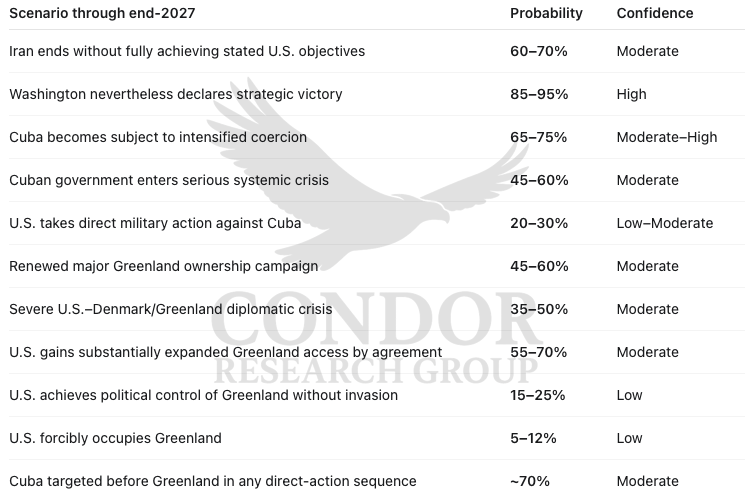
We estimate:
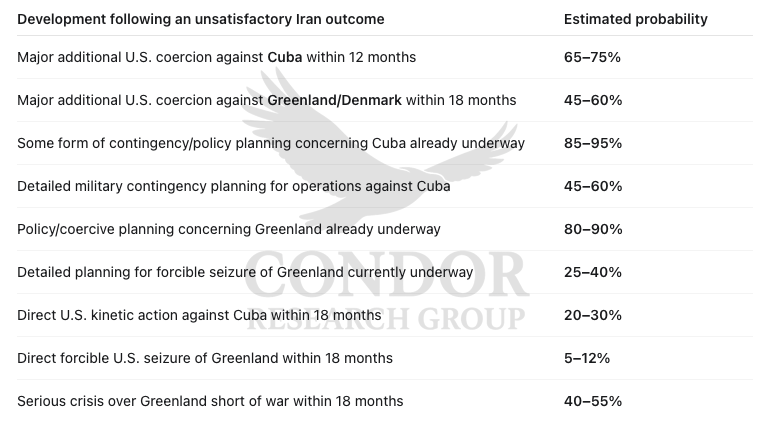
These are CRG analytic estimates, not observed statistical frequencies.
The central distinction is important:
Cuba offers Washington a plausible victory. Greenland offers Washington an easy occupation but potentially a catastrophic victory.
A Cuban confrontation could be framed domestically as the completion of the Venezuela campaign and removal of a hostile regime 145 km from Florida. A Greenland seizure would place the United States in direct confrontation with Denmark and potentially destroy the political foundation of NATO.
Therefore, if Washington seeks a compensatory demonstration of strength following Iran, Cuba is the more probable first objective.
⸻
I. THE IRAN FAILURE CONDITION
For this assessment, an American “failure” in Iran does not mean battlefield defeat.
The United States possesses overwhelming conventional military superiority and has inflicted very substantial damage. CENTCOM reported more than 9,000 targets struck during the first 24 days of Operation Epic Fury alone.
The strategic problem is different.
A war can be operationally successful and strategically unsuccessful.
A failure condition would exist if Washington ultimately accepts an outcome in which several of the following remain true:
The administration publicly defined those objectives as destroying Iranian missile production, annihilating its navy, cutting support to proxies and preventing an Iranian nuclear weapon.
By August, Reuters was describing Washington as facing an Iran war with “no exit in sight,” while negotiations surrounding Hormuz contemplated arrangements giving Tehran continuing influence over passage through the Strait.
The political danger for Washington is consequently not necessarily losing militarily.
It is winning battles without producing submission.
That distinction drives the remainder of this assessment.
⸻
II. WHY ANOTHER TARGET COULD BECOME ATTRACTIVE
An inconclusive Iran outcome would create four pressures.
1. Restoration of deterrence
Adversaries could interpret Iranian survival as evidence that sufficiently resilient states can absorb enormous U.S. punishment without conceding their fundamental objectives.
Washington would have an incentive to demonstrate that Iran was exceptional rather than evidence of declining American coercive power.
2. Domestic political narrative
The administration would need an identifiable accomplishment which can be communicated much more simply than:
Iran suffered enormous military damage but accepted only some American demands after a prolonged and expensive campaign.
Venezuela has already established a precedent for comparatively abrupt intervention followed by U.S. political leverage over the successor government. Seven months after the January operation removing Nicolás Maduro, Washington remains deeply involved in Venezuela’s political trajectory.
3. Target substitution
Major powers encountering an expensive resistant opponent sometimes redirect political energy toward an objective offering a more favourable correlation between cost and visible result.
Both Cuba and Greenland already exist in the administration’s strategic agenda.
No new doctrine needs to be invented.
4. Presidential credibility
Greenland is particularly interesting because ownership has repeatedly been presented publicly as an American objective rather than merely increased military access.
Trump reiterated in January that the United States should acquire Greenland and refused to exclude force.
Consequently, an unresolved Greenland issue can itself eventually become interpreted as another test of presidential credibility.
⸻
III. TARGET ONE — CUBA
Current position
Cuba is already undergoing escalating U.S. coercion.
On 29 January 2026, Washington formally declared Cuba an “unusual and extraordinary threat” to U.S. national security and established mechanisms targeting countries supplying Cuba with oil.
Additional sanctions followed on 1 May, including broader authorities against individuals, institutions and financial entities connected with the Cuban state.
Further Cuba sanctions were imposed on 6 August 2026 — yesterday relative to this assessment.
This is therefore not a dormant target.
Cuba is an active coercive campaign.
The pressure is having material consequences. Cuba has experienced repeated nationwide electricity collapses, with Reuters reporting that the U.S. oil blockade has sharply restricted fuel availability following the removal of Maduro and the cessation of Mexican oil deliveries under American pressure.
That makes Cuba increasingly vulnerable without requiring American invasion.
⸻
IV. WHY CUBA WOULD PROBABLY COME FIRST
Cuba possesses six attributes making it particularly attractive after Iran.
Geographic proximity. Operations can be sustained from the continental United States and existing regional bases with minimal logistical complexity compared with Middle Eastern operations.
Political familiarity. Cuba has occupied a unique position in U.S. domestic politics for more than six decades.
Existing legal and rhetorical preparation. Washington has already formally declared the Cuban government a national-security threat.
Economic vulnerability. The Cuban energy system is already approaching critical levels of fragility.
Venezuela precedent. The January 2026 intervention established that this administration is willing to undertake direct action against a Latin American government rather than confining itself to sanctions.
Narrative simplicity. Regime collapse in Havana could be presented as removal of one of the Western Hemisphere’s longest-standing anti-American governments.
This produces an unusually favourable political equation.
CRG estimate
Probability that Cuba experiences substantial additional U.S. pressure within 12 months of an inconclusive Iran settlement: 65–75%.
This does not mean a 65–75% probability of invasion.
Most pathways remain coercive:
economic isolation → energy strangulation → political destabilisation → elite fragmentation → negotiated transition.
Military intervention would become substantially more probable only if Cuban internal instability produced an apparent opportunity for a short-duration decapitation or intervention operation.
⸻
V. CUBAN KINETIC ESCALATION
We estimate the probability of overt U.S. military action against Cuba during the next 18 months at approximately:
20–30%
conditional upon the Iran conflict ending without an American strategic victory.
Without that condition, CRG would place the probability appreciably lower.
Cuba has already warned publicly that American military action would produce extensive resistance. The warning followed reports concerning Cuban acquisition of hundreds of military drones and alleged threats to Guantánamo, which Havana denies.
This matters because Cuba is not Panama in 1989.
The regime possesses:
Removing the leadership might be relatively easy.
Managing Cuba afterward would not necessarily be easy.
This is the principal constraint on direct intervention.
⸻
VI. TARGET TWO — GREENLAND
Greenland presents almost the inverse strategic equation.
Operationally, Greenland is extraordinarily favourable. Politically, it is extraordinarily dangerous.
The United States already operates Pituffik Space Base and possesses extensive historical experience operating military installations across Greenland. Existing U.S.-Danish defence arrangements give Washington considerable scope for expanded military access without sovereignty transfer.
Indeed, this is precisely why a forcible acquisition is strategically difficult to justify: Washington can obtain much of the military utility it wants without owning Greenland.
Reporting in early 2026 indicated U.S. interest in expanding access to additional Greenlandic installations and infrastructure.
Meanwhile, Trump has repeatedly insisted that ownership itself matters and has declined to remove military force from consideration. That makes Greenland fundamentally different from an ordinary Arctic basing negotiation.
⸻
VII. IS GREENLAND AN “EASY WIN”?
Militarily: yes.
Strategically: almost certainly no.
The physical seizure of Greenland would present limited conventional opposition.
Greenland has approximately 57,000 inhabitants scattered over an enormous territory. Denmark could not independently contest U.S. military supremacy.
In narrow operational terms, occupying Nuuk, airports, ports, communications nodes and government facilities would be straightforward.
But this is the wrong measure of success.
Greenland belongs to the Kingdom of Denmark.
Denmark is a NATO member.
A forcible American seizure would therefore mean one NATO state attacking the territory of another.
Reuters reported in January that European governments regarded precisely this possibility as potentially threatening NATO’s survival.
Denmark has since increased military preparations and on 3 August 2026 began implementing expanded conscription, including plans eventually to deploy conscripts to Greenland.
The strategic balance therefore looks like this:
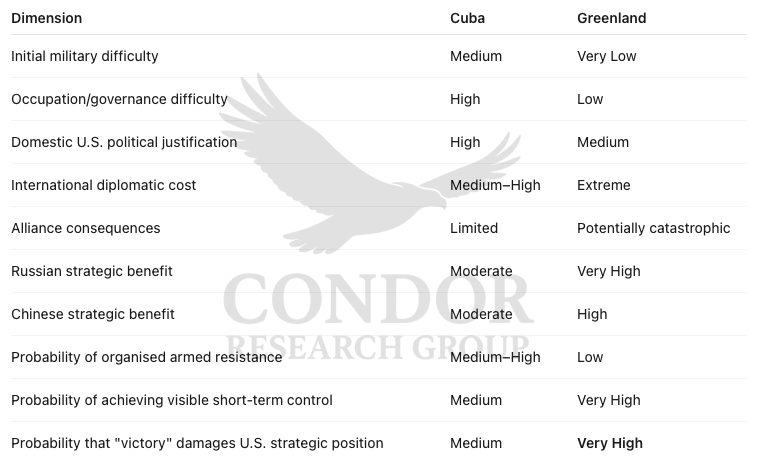
Thus:
Greenland may be one of the easiest territories in the world for the United States to seize and one of the most expensive for it to possess by force.
⸻
VIII. WHICH COMES FIRST?
CRG assessment: Cuba first — approximately 70:30 over Greenland.
This does not necessarily mean invasion.
The probable sequence is:
Iran settlement or strategic stalemate
↓
Administration attempts to redefine Iran outcome as victory
↓
Simultaneous pressure on Cuba and renewed Greenland demands
↓
Cuba becomes primary coercive target
↓
Greenland remains leverage campaign unless Denmark/Greenland creates a political opening
Cuba already occupies a much more advanced position on the escalation ladder.
Greenland is currently an acquisition dispute.
Cuba is already subject to what effectively amounts to a strategic strangulation campaign.
That distinction is decisive.
⸻
IX. TIME HORIZON
Cuba
0–6 months
High probability
6–12 months
Moderate-to-high probability
If Cuban infrastructure continues degrading:
6–18 months
Low-to-moderate probability of kinetic action: 20–30%
Most plausible trigger:
internal Cuban disorder + perceived opportunity for rapid leadership removal.
⸻
Greenland
0–6 months
Likely continued:
6–18 months
Potential renewed ownership confrontation if Iran ends badly politically for Washington.
Probability of significant renewed coercive confrontation:
45–60%
12–36 months
This is the more dangerous Greenland window.
If negotiations repeatedly fail while the administration remains committed to ownership, Greenland could increasingly become a credibility problem.
Direct military seizure nevertheless remains unlikely:
5–12% within 18 months
and approximately
10–20% over 36 months
assuming the political objective of U.S. ownership itself remains unchanged.
⸻
X. ARE PLANS ALREADY IN THE WORKS?
The word plans requires distinction.
Every competent major military maintains contingency planning.
Existence of a plan does not demonstrate intent to execute it.
Cuba
We assess:
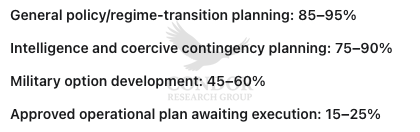
The very high policy-planning estimate follows from existing sanctions, the oil campaign, Venezuela policy and formal designation of Cuba as a national-security threat.
⸻
Greenland
We assess:
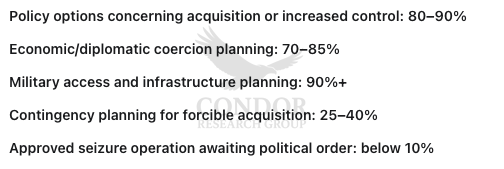
In January, U.S. officials told The New York Times that the Pentagon had not at that point been ordered to prepare an invasion plan, despite Trump’s repeated statements about acquiring Greenland.
That is useful evidence against claiming that an invasion plan was already operational at that time. It does not, however, establish that no contingency work has occurred subsequently.
⸻
XI. THE IRAN–CUBA–GREENLAND CONNECTION
The greatest analytical mistake would be to interpret these as independent theatres.
They form part of a wider credibility system.
An unsatisfactory Iranian outcome could encourage Russia, China and middle powers to conclude that American conventional superiority does not necessarily translate into strategic compellence.
Washington would therefore face incentives to demonstrate the opposite. Cuba and Greenland provide different demonstrations.
Cuba demonstrates:
hostile regimes in the Western Hemisphere cannot survive sustained American pressure.
Greenland demonstrates:
American strategic requirements override even allied objections.
The first reinforces a sphere of influence.
The second transforms the alliance system itself.
For that reason Cuba is strategically safer.
⸻
XII. THE RUSSIAN AND CHINESE RESPONSE
A Greenland seizure would constitute an extraordinary strategic gift to Moscow.
Russia could immediately argue:
China would make parallel arguments concerning international order and U.S. double standards.
The damage could extend well beyond Europe. Japan, South Korea, Australia and other U.S. partners would have to reconsider the distinction between alliance with Washington and dependency upon Washington.
This is why Greenland cannot properly be classified as an easy geopolitical win.
The occupation could be completed before the strategic losses had even begun to accumulate.
⸻
XIII. NATO AS THE PRIMARY GREENLAND DETERRENT
The principal deterrent protecting Greenland is therefore not Danish military strength.
It is the value Washington attaches to the political architecture surrounding Denmark.
A U.S.-Danish military confrontation could:
That price makes military action difficult to rationalise even if Greenland itself could be controlled almost immediately.
⸻
XIV. THE MOST DANGEROUS GREENLAND SCENARIO
The most plausible route to American control is therefore not invasion.
It is gradual transformation of sovereignty.
Possible pathway:
Greenlandic independence
→ bilateral U.S.-Greenland security arrangements
→ major American investment
→ preferential economic relationship
→ expanded basing
→ free-association style arrangement
→ effective American strategic control without formal annexation.
This represents a much more viable American strategy.
It could produce nearly all of the strategic benefits of annexation while avoiding an attack on Denmark.
Consequently, indications of American activity surrounding Greenlandic political independence deserve greater analytic attention than troop movements alone.
⸻
XV. KEY INDICATORS AND WARNINGS
CRG would regard the following as significant escalation indicators:
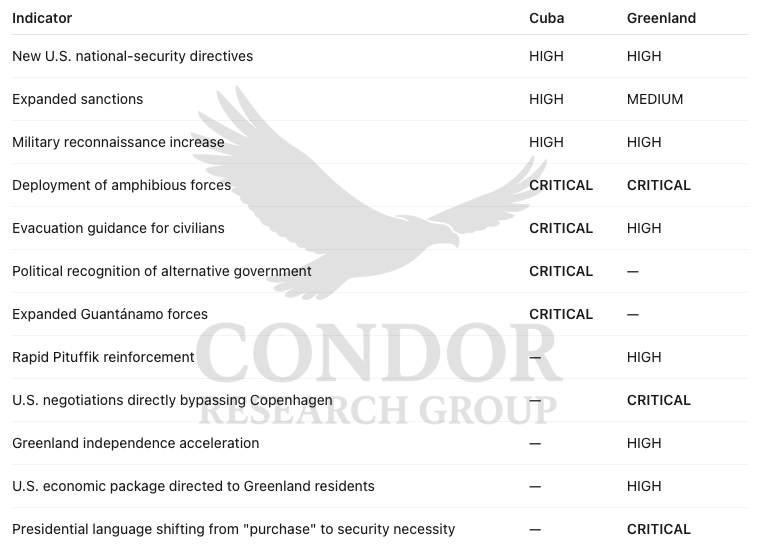
For Cuba particularly, the point of maximum danger would not necessarily coincide with maximum Cuban strength.
It would probably occur at maximum Cuban weakness.
⸻
XVI. ALTERNATIVE OUTCOME: NO SECOND WAR
There is an important competing hypothesis.
Failure in Iran could make another military operation less, rather than more, attractive.
A prolonged Iranian conflict could:
Congress was already considering resolutions in July directing removal of U.S. forces from hostilities with Iran.
Consequently, the compensatory-victory hypothesis operates most strongly when the administration concludes:
The problem was Iran’s difficulty, not military intervention itself.
If instead Washington concludes:
The problem was attempting coercive regime transformation through military force,
then both Cuba and Greenland become less likely kinetic targets.
This is the principal uncertainty in the assessment.
⸻
XVII. CRG PROBABILITY MATRIX
⸻
XVIII. OTHER CONSIDERATIONS
There are five factors particularly worth watching.
First, Venezuela matters more than Iran in predicting Cuba. Washington has already demonstrated willingness to overthrow a government in Cuba’s immediate strategic network. Cuban personnel were killed during the Venezuela intervention, and subsequent American pressure has pushed remaining Cuban security personnel out of key Venezuelan positions.
Second, Greenland could become more attractive precisely because it requires little fighting. If the administration wants a visible territorial accomplishment after a frustrating war, the military asymmetry is obvious. The deterrent is political consequence, not military difficulty.
Third, Iran could accelerate rather than delay both campaigns. If Washington believes it must reduce exposure to Eurasian supply chokepoints, Greenland’s Arctic position and resources acquire additional strategic value. The Iran war has already intensified global concern about energy security following disruption around Hormuz.
Fourth, the two targets are not mutually exclusive. Cuba could undergo coercive regime-change pressure while Greenland simultaneously experiences diplomatic and economic coercion.
Fifth, the highest probability outcome involves neither invasion. Washington can exert enormous leverage against Cuba through energy isolation and against Greenland through security, economic and political arrangements.
⸻
XIX. FINAL ASSESSMENT
CRG assesses that a failure to convert overwhelming American military superiority against Iran into an unambiguous political victory would create a credibility deficit for Washington.
A weaker opponent offering a clearer result would consequently become more attractive.
Between the two candidates examined here:
CUBA IS THE MORE LIKELY FIRST TARGET.
It is already under escalating American pressure, possesses a political system Washington explicitly identifies as a national-security threat, has been weakened by the loss of Venezuelan support, and provides a readily understandable domestic narrative.
GREENLAND IS THE MORE TEMPTING “EASY WIN,” BUT ONLY WHEN VIEWED THROUGH AN OPERATIONAL LENS.
The United States could almost certainly establish physical control rapidly.
But doing so by force could convert a tactical victory into one of the largest self-inflicted strategic reversals in post-1945 American history.
The more rational Greenland strategy is therefore control without conquest: expanded bases, infrastructure, economic penetration, political influence and ultimately a bilateral relationship with an increasingly autonomous or independent Greenland.
Accordingly, the principal post-Iran risk is not:
Iran → Greenland invasion.
The more plausible strategic progression is:
Iranian strategic stalemate → demand for restoration of U.S. coercive credibility → intensified Cuban destabilisation → renewed Greenland pressure → pursuit of control through coercion or negotiated political transformation.
The critical warning would arise if Washington began treating political victory itself as a scarce strategic resource.
At that point, weak adversaries and unresolved territorial objectives cease to be separate policy problems.
They become opportunities for compensatory victory.
⸻
Principal Sources
The assessment draws primarily on current U.S. government statements and contemporaneous reporting: the Department of Defense’s Operation Epic Fury fact sheet and White House descriptions of U.S. objectives in Iran; Reuters reporting of 1–7 August 2026 concerning the Iran war, Hormuz, U.S. public opinion, Cuba sanctions and Cuba’s energy crisis; White House Executive Orders 14380 and 14404 concerning Cuba; Reuters reporting on U.S.-Greenland tensions and Danish Arctic defence measures; and reporting on Pentagon and administration consideration of Greenland options.
Document: CRG-US-INT-0826/1: The Compensatory Victory Problem – Strategic Consequences of an Unsuccessful U.S. War with Iran and the Relative Attractiveness of Cuba and Greenland
Classification: Strategic Intelligence Assessment (Scenario Analysis)
Distribution: Public Release
Revision Status: Final — Approved for internal CRG circulation, external academic reference, and web publication
Authorized By: Condor Research Group (CRG)
Division: Geopolitical & Strategic Intelligence Division
Original Draft Date: August 2026
Release Date: 7 August 2026
Version: CRG-INT-VER-A1-FINAL
Keywords: United States, Iran, Cuba, Greenland, Denmark, NATO, Strategic Credibility, Compensatory Victory, Coercive Strategy, Regime Change, Arctic Security, Western Hemisphere, Strategic Planning
Publication Note: Published on the Condor Research Group website as part of the CRG Strategic Intelligence Assessment series. This paper presents a strategic contingency analysis examining potential consequences of an inconclusive U.S. war with Iran and does not assert that the United States or any other state intends to undertake the actions examined.
THE COMPENSATORY VICTORY PROBLEM
Strategic Consequences of an Unsuccessful U.S. War with Iran and the Relative Attractiveness of Cuba and Greenland
Condor Research Group (CRG)
Political-Military Intelligence Assessment
Date: 7 August 2026
Classification: UNCLASSIFIED // ANALYTIC ASSESSMENT
Confidence: Moderate
⸻
EXECUTIVE ASSESSMENT
We assess with moderate confidence that an Iran war ending without a recognisable American strategic victory would increase pressure inside the U.S. administration to demonstrate that American coercive power remains effective elsewhere. This would not automatically produce another war. It would, however, make unresolved objectives against weaker states or territories substantially more politically attractive.
The Iran conflict has already moved into precisely the strategic territory in which such behaviour becomes conceivable. The war has lasted approximately five months; several original objectives remain unresolved; public support is weak; economic costs have accumulated; disruption of the Strait of Hormuz remains a major strategic problem; and Washington recently postponed another attack while searching for a negotiated outcome.
Under these circumstances, Cuba is more likely than Greenland to become the first target of a renewed American coercive campaign.
We estimate:
These are CRG analytic estimates, not observed statistical frequencies.
The central distinction is important:
Cuba offers Washington a plausible victory. Greenland offers Washington an easy occupation but potentially a catastrophic victory.
A Cuban confrontation could be framed domestically as the completion of the Venezuela campaign and removal of a hostile regime 145 km from Florida. A Greenland seizure would place the United States in direct confrontation with Denmark and potentially destroy the political foundation of NATO.
Therefore, if Washington seeks a compensatory demonstration of strength following Iran, Cuba is the more probable first objective.
⸻
I. THE IRAN FAILURE CONDITION
For this assessment, an American “failure” in Iran does not mean battlefield defeat.
The United States possesses overwhelming conventional military superiority and has inflicted very substantial damage. CENTCOM reported more than 9,000 targets struck during the first 24 days of Operation Epic Fury alone.
The strategic problem is different.
A war can be operationally successful and strategically unsuccessful.
A failure condition would exist if Washington ultimately accepts an outcome in which several of the following remain true:
- the Iranian political system survives;
- Iran retains or reconstructs meaningful missile and nuclear capabilities;
- Washington cannot guarantee unrestricted navigation through Hormuz;
- U.S. economic costs remain substantial;
- Iranian regional influence survives sufficiently to claim resistance;
- the United States accepts a negotiated settlement visibly below its original objectives.
The administration publicly defined those objectives as destroying Iranian missile production, annihilating its navy, cutting support to proxies and preventing an Iranian nuclear weapon.
By August, Reuters was describing Washington as facing an Iran war with “no exit in sight,” while negotiations surrounding Hormuz contemplated arrangements giving Tehran continuing influence over passage through the Strait.
The political danger for Washington is consequently not necessarily losing militarily.
It is winning battles without producing submission.
That distinction drives the remainder of this assessment.
⸻
II. WHY ANOTHER TARGET COULD BECOME ATTRACTIVE
An inconclusive Iran outcome would create four pressures.
1. Restoration of deterrence
Adversaries could interpret Iranian survival as evidence that sufficiently resilient states can absorb enormous U.S. punishment without conceding their fundamental objectives.
Washington would have an incentive to demonstrate that Iran was exceptional rather than evidence of declining American coercive power.
2. Domestic political narrative
The administration would need an identifiable accomplishment which can be communicated much more simply than:
Iran suffered enormous military damage but accepted only some American demands after a prolonged and expensive campaign.
Venezuela has already established a precedent for comparatively abrupt intervention followed by U.S. political leverage over the successor government. Seven months after the January operation removing Nicolás Maduro, Washington remains deeply involved in Venezuela’s political trajectory.
3. Target substitution
Major powers encountering an expensive resistant opponent sometimes redirect political energy toward an objective offering a more favourable correlation between cost and visible result.
Both Cuba and Greenland already exist in the administration’s strategic agenda.
No new doctrine needs to be invented.
4. Presidential credibility
Greenland is particularly interesting because ownership has repeatedly been presented publicly as an American objective rather than merely increased military access.
Trump reiterated in January that the United States should acquire Greenland and refused to exclude force.
Consequently, an unresolved Greenland issue can itself eventually become interpreted as another test of presidential credibility.
⸻
III. TARGET ONE — CUBA
Current position
Cuba is already undergoing escalating U.S. coercion.
On 29 January 2026, Washington formally declared Cuba an “unusual and extraordinary threat” to U.S. national security and established mechanisms targeting countries supplying Cuba with oil.
Additional sanctions followed on 1 May, including broader authorities against individuals, institutions and financial entities connected with the Cuban state.
Further Cuba sanctions were imposed on 6 August 2026 — yesterday relative to this assessment.
This is therefore not a dormant target.
Cuba is an active coercive campaign.
The pressure is having material consequences. Cuba has experienced repeated nationwide electricity collapses, with Reuters reporting that the U.S. oil blockade has sharply restricted fuel availability following the removal of Maduro and the cessation of Mexican oil deliveries under American pressure.
That makes Cuba increasingly vulnerable without requiring American invasion.
⸻
IV. WHY CUBA WOULD PROBABLY COME FIRST
Cuba possesses six attributes making it particularly attractive after Iran.
Geographic proximity. Operations can be sustained from the continental United States and existing regional bases with minimal logistical complexity compared with Middle Eastern operations.
Political familiarity. Cuba has occupied a unique position in U.S. domestic politics for more than six decades.
Existing legal and rhetorical preparation. Washington has already formally declared the Cuban government a national-security threat.
Economic vulnerability. The Cuban energy system is already approaching critical levels of fragility.
Venezuela precedent. The January 2026 intervention established that this administration is willing to undertake direct action against a Latin American government rather than confining itself to sanctions.
Narrative simplicity. Regime collapse in Havana could be presented as removal of one of the Western Hemisphere’s longest-standing anti-American governments.
This produces an unusually favourable political equation.
CRG estimate
Probability that Cuba experiences substantial additional U.S. pressure within 12 months of an inconclusive Iran settlement: 65–75%.
This does not mean a 65–75% probability of invasion.
Most pathways remain coercive:
economic isolation → energy strangulation → political destabilisation → elite fragmentation → negotiated transition.
Military intervention would become substantially more probable only if Cuban internal instability produced an apparent opportunity for a short-duration decapitation or intervention operation.
⸻
V. CUBAN KINETIC ESCALATION
We estimate the probability of overt U.S. military action against Cuba during the next 18 months at approximately:
20–30%
conditional upon the Iran conflict ending without an American strategic victory.
Without that condition, CRG would place the probability appreciably lower.
Cuba has already warned publicly that American military action would produce extensive resistance. The warning followed reports concerning Cuban acquisition of hundreds of military drones and alleged threats to Guantánamo, which Havana denies.
This matters because Cuba is not Panama in 1989.
The regime possesses:
- established internal-security institutions;
- extensive military infrastructure;
- decades of preparation for confrontation with the United States;
- difficult urban terrain;
- a population of approximately ten million;
- considerable nationalist potential even among citizens dissatisfied with the government.
Removing the leadership might be relatively easy.
Managing Cuba afterward would not necessarily be easy.
This is the principal constraint on direct intervention.
⸻
VI. TARGET TWO — GREENLAND
Greenland presents almost the inverse strategic equation.
Operationally, Greenland is extraordinarily favourable. Politically, it is extraordinarily dangerous.
The United States already operates Pituffik Space Base and possesses extensive historical experience operating military installations across Greenland. Existing U.S.-Danish defence arrangements give Washington considerable scope for expanded military access without sovereignty transfer.
Indeed, this is precisely why a forcible acquisition is strategically difficult to justify: Washington can obtain much of the military utility it wants without owning Greenland.
Reporting in early 2026 indicated U.S. interest in expanding access to additional Greenlandic installations and infrastructure.
Meanwhile, Trump has repeatedly insisted that ownership itself matters and has declined to remove military force from consideration. That makes Greenland fundamentally different from an ordinary Arctic basing negotiation.
⸻
VII. IS GREENLAND AN “EASY WIN”?
Militarily: yes.
Strategically: almost certainly no.
The physical seizure of Greenland would present limited conventional opposition.
Greenland has approximately 57,000 inhabitants scattered over an enormous territory. Denmark could not independently contest U.S. military supremacy.
In narrow operational terms, occupying Nuuk, airports, ports, communications nodes and government facilities would be straightforward.
But this is the wrong measure of success.
Greenland belongs to the Kingdom of Denmark.
Denmark is a NATO member.
A forcible American seizure would therefore mean one NATO state attacking the territory of another.
Reuters reported in January that European governments regarded precisely this possibility as potentially threatening NATO’s survival.
Denmark has since increased military preparations and on 3 August 2026 began implementing expanded conscription, including plans eventually to deploy conscripts to Greenland.
The strategic balance therefore looks like this:
Thus:
Greenland may be one of the easiest territories in the world for the United States to seize and one of the most expensive for it to possess by force.
⸻
VIII. WHICH COMES FIRST?
CRG assessment: Cuba first — approximately 70:30 over Greenland.
This does not necessarily mean invasion.
The probable sequence is:
Iran settlement or strategic stalemate
↓
Administration attempts to redefine Iran outcome as victory
↓
Simultaneous pressure on Cuba and renewed Greenland demands
↓
Cuba becomes primary coercive target
↓
Greenland remains leverage campaign unless Denmark/Greenland creates a political opening
Cuba already occupies a much more advanced position on the escalation ladder.
Greenland is currently an acquisition dispute.
Cuba is already subject to what effectively amounts to a strategic strangulation campaign.
That distinction is decisive.
⸻
IX. TIME HORIZON
Cuba
0–6 months
High probability
- intensified sanctions;
- secondary sanctions;
- pressure on remaining oil suppliers;
- encouragement of elite defections;
- increased information operations;
- intelligence support for opposition networks;
- maritime/interdiction pressure.
6–12 months
Moderate-to-high probability
If Cuban infrastructure continues degrading:
- severe political instability;
- organised regime-transition pressure;
- demands for governmental concessions;
- potential U.S. recognition of alternative political authorities.
6–18 months
Low-to-moderate probability of kinetic action: 20–30%
Most plausible trigger:
internal Cuban disorder + perceived opportunity for rapid leadership removal.
⸻
Greenland
0–6 months
Likely continued:
- basing negotiations;
- Arctic-security arguments;
- diplomatic pressure;
- economic inducements;
- political messaging directed at Greenlanders.
6–18 months
Potential renewed ownership confrontation if Iran ends badly politically for Washington.
Probability of significant renewed coercive confrontation:
45–60%
12–36 months
This is the more dangerous Greenland window.
If negotiations repeatedly fail while the administration remains committed to ownership, Greenland could increasingly become a credibility problem.
Direct military seizure nevertheless remains unlikely:
5–12% within 18 months
and approximately
10–20% over 36 months
assuming the political objective of U.S. ownership itself remains unchanged.
⸻
X. ARE PLANS ALREADY IN THE WORKS?
The word plans requires distinction.
Every competent major military maintains contingency planning.
Existence of a plan does not demonstrate intent to execute it.
Cuba
We assess:
The very high policy-planning estimate follows from existing sanctions, the oil campaign, Venezuela policy and formal designation of Cuba as a national-security threat.
⸻
Greenland
We assess:
In January, U.S. officials told The New York Times that the Pentagon had not at that point been ordered to prepare an invasion plan, despite Trump’s repeated statements about acquiring Greenland.
That is useful evidence against claiming that an invasion plan was already operational at that time. It does not, however, establish that no contingency work has occurred subsequently.
⸻
XI. THE IRAN–CUBA–GREENLAND CONNECTION
The greatest analytical mistake would be to interpret these as independent theatres.
They form part of a wider credibility system.
An unsatisfactory Iranian outcome could encourage Russia, China and middle powers to conclude that American conventional superiority does not necessarily translate into strategic compellence.
Washington would therefore face incentives to demonstrate the opposite. Cuba and Greenland provide different demonstrations.
Cuba demonstrates:
hostile regimes in the Western Hemisphere cannot survive sustained American pressure.
Greenland demonstrates:
American strategic requirements override even allied objections.
The first reinforces a sphere of influence.
The second transforms the alliance system itself.
For that reason Cuba is strategically safer.
⸻
XII. THE RUSSIAN AND CHINESE RESPONSE
A Greenland seizure would constitute an extraordinary strategic gift to Moscow.
Russia could immediately argue:
- territorial acquisition by force has been normalised;
- NATO’s sovereignty arguments regarding Ukraine are hypocritical;
- NATO security guarantees are meaningless;
- European states cannot rely upon Washington;
- American power itself threatens European territorial integrity.
China would make parallel arguments concerning international order and U.S. double standards.
The damage could extend well beyond Europe. Japan, South Korea, Australia and other U.S. partners would have to reconsider the distinction between alliance with Washington and dependency upon Washington.
This is why Greenland cannot properly be classified as an easy geopolitical win.
The occupation could be completed before the strategic losses had even begun to accumulate.
⸻
XIII. NATO AS THE PRIMARY GREENLAND DETERRENT
The principal deterrent protecting Greenland is therefore not Danish military strength.
It is the value Washington attaches to the political architecture surrounding Denmark.
A U.S.-Danish military confrontation could:
- paralyse NATO decision-making;
- generate demands for withdrawal of American forces from European bases;
- weaken intelligence cooperation;
- reduce European support for U.S. operations elsewhere;
- accelerate European strategic autonomy;
- strengthen Russian influence;
- profoundly damage U.S. legitimacy.
That price makes military action difficult to rationalise even if Greenland itself could be controlled almost immediately.
⸻
XIV. THE MOST DANGEROUS GREENLAND SCENARIO
The most plausible route to American control is therefore not invasion.
It is gradual transformation of sovereignty.
Possible pathway:
Greenlandic independence
→ bilateral U.S.-Greenland security arrangements
→ major American investment
→ preferential economic relationship
→ expanded basing
→ free-association style arrangement
→ effective American strategic control without formal annexation.
This represents a much more viable American strategy.
It could produce nearly all of the strategic benefits of annexation while avoiding an attack on Denmark.
Consequently, indications of American activity surrounding Greenlandic political independence deserve greater analytic attention than troop movements alone.
⸻
XV. KEY INDICATORS AND WARNINGS
CRG would regard the following as significant escalation indicators:
For Cuba particularly, the point of maximum danger would not necessarily coincide with maximum Cuban strength.
It would probably occur at maximum Cuban weakness.
⸻
XVI. ALTERNATIVE OUTCOME: NO SECOND WAR
There is an important competing hypothesis.
Failure in Iran could make another military operation less, rather than more, attractive.
A prolonged Iranian conflict could:
- exhaust political tolerance for intervention;
- consume precision munitions;
- increase naval maintenance requirements;
- expose air-defence stockpile limitations;
- weaken public support;
- increase fiscal pressures;
- encourage Congress to restrain further hostilities.
Congress was already considering resolutions in July directing removal of U.S. forces from hostilities with Iran.
Consequently, the compensatory-victory hypothesis operates most strongly when the administration concludes:
The problem was Iran’s difficulty, not military intervention itself.
If instead Washington concludes:
The problem was attempting coercive regime transformation through military force,
then both Cuba and Greenland become less likely kinetic targets.
This is the principal uncertainty in the assessment.
⸻
XVII. CRG PROBABILITY MATRIX
⸻
XVIII. OTHER CONSIDERATIONS
There are five factors particularly worth watching.
First, Venezuela matters more than Iran in predicting Cuba. Washington has already demonstrated willingness to overthrow a government in Cuba’s immediate strategic network. Cuban personnel were killed during the Venezuela intervention, and subsequent American pressure has pushed remaining Cuban security personnel out of key Venezuelan positions.
Second, Greenland could become more attractive precisely because it requires little fighting. If the administration wants a visible territorial accomplishment after a frustrating war, the military asymmetry is obvious. The deterrent is political consequence, not military difficulty.
Third, Iran could accelerate rather than delay both campaigns. If Washington believes it must reduce exposure to Eurasian supply chokepoints, Greenland’s Arctic position and resources acquire additional strategic value. The Iran war has already intensified global concern about energy security following disruption around Hormuz.
Fourth, the two targets are not mutually exclusive. Cuba could undergo coercive regime-change pressure while Greenland simultaneously experiences diplomatic and economic coercion.
Fifth, the highest probability outcome involves neither invasion. Washington can exert enormous leverage against Cuba through energy isolation and against Greenland through security, economic and political arrangements.
⸻
XIX. FINAL ASSESSMENT
CRG assesses that a failure to convert overwhelming American military superiority against Iran into an unambiguous political victory would create a credibility deficit for Washington.
A weaker opponent offering a clearer result would consequently become more attractive.
Between the two candidates examined here:
CUBA IS THE MORE LIKELY FIRST TARGET.
It is already under escalating American pressure, possesses a political system Washington explicitly identifies as a national-security threat, has been weakened by the loss of Venezuelan support, and provides a readily understandable domestic narrative.
GREENLAND IS THE MORE TEMPTING “EASY WIN,” BUT ONLY WHEN VIEWED THROUGH AN OPERATIONAL LENS.
The United States could almost certainly establish physical control rapidly.
But doing so by force could convert a tactical victory into one of the largest self-inflicted strategic reversals in post-1945 American history.
The more rational Greenland strategy is therefore control without conquest: expanded bases, infrastructure, economic penetration, political influence and ultimately a bilateral relationship with an increasingly autonomous or independent Greenland.
Accordingly, the principal post-Iran risk is not:
Iran → Greenland invasion.
The more plausible strategic progression is:
Iranian strategic stalemate → demand for restoration of U.S. coercive credibility → intensified Cuban destabilisation → renewed Greenland pressure → pursuit of control through coercion or negotiated political transformation.
The critical warning would arise if Washington began treating political victory itself as a scarce strategic resource.
At that point, weak adversaries and unresolved territorial objectives cease to be separate policy problems.
They become opportunities for compensatory victory.
⸻
Principal Sources
The assessment draws primarily on current U.S. government statements and contemporaneous reporting: the Department of Defense’s Operation Epic Fury fact sheet and White House descriptions of U.S. objectives in Iran; Reuters reporting of 1–7 August 2026 concerning the Iran war, Hormuz, U.S. public opinion, Cuba sanctions and Cuba’s energy crisis; White House Executive Orders 14380 and 14404 concerning Cuba; Reuters reporting on U.S.-Greenland tensions and Danish Arctic defence measures; and reporting on Pentagon and administration consideration of Greenland options.
Document: CRG-US-INT-0826/1: The Compensatory Victory Problem – Strategic Consequences of an Unsuccessful U.S. War with Iran and the Relative Attractiveness of Cuba and Greenland
Classification: Strategic Intelligence Assessment (Scenario Analysis)
Distribution: Public Release
Revision Status: Final — Approved for internal CRG circulation, external academic reference, and web publication
Authorized By: Condor Research Group (CRG)
Division: Geopolitical & Strategic Intelligence Division
Original Draft Date: August 2026
Release Date: 7 August 2026
Version: CRG-INT-VER-A1-FINAL
Keywords: United States, Iran, Cuba, Greenland, Denmark, NATO, Strategic Credibility, Compensatory Victory, Coercive Strategy, Regime Change, Arctic Security, Western Hemisphere, Strategic Planning
Publication Note: Published on the Condor Research Group website as part of the CRG Strategic Intelligence Assessment series. This paper presents a strategic contingency analysis examining potential consequences of an inconclusive U.S. war with Iran and does not assert that the United States or any other state intends to undertake the actions examined.