CRG-INT-0326/3: How Iran Wins Without Winning
Classification: Strategic Outcome Inversion
Division: Strategic Forecasting & Outcome Modeling (SFOM)
Timestamp: March 2026
Executive Summary
Iran does not need to win the war.
It only needs to ensure that:
- the war does not end
- the system does not stabilize
- the cost curve continues to rise for its adversaries
Under these conditions:
Iran achieves strategic success without battlefield victory
Doctrinal Premise
Conventional victory requires:
- territorial control
- regime collapse of the opponent
- decisive military superiority
Iran is not pursuing these.
Instead, it operates within the logic of asymmetric warfare, where the weaker actor offsets military inferiority by targeting systemic vulnerabilities rather than battlefield outcomes
CRG Translation:
Victory is redefined as denial of closure
Phase Inversion Model
Phase I — Absorb
- Accept initial strikes
- Preserve command continuity
- Harden critical infrastructure
This aligns with what analysts describe as “asymmetric endurance”—absorbing damage while preserving second-strike capability
Effect:
Removes the possibility of rapid victory for the attacker.
Phase II — Disperse
- Activate proxy network (Lebanon, Iraq, Yemen, Syria)
- Decentralize operational control
- Increase deniability
Iran’s proxy architecture was designed specifically to survive direct attacks and continue operating independently.
Effect:
Transforms a bilateral war into a multi-node system conflict
Phase III — Stretch
- Expand conflict across domains:
- maritime disruption
- drone warfare
- cyber pressure
- Target logistics, not just military assets
Low-cost systems (e.g., drones) impose disproportionate costs on advanced defenses. The system does not escalate because actors choose to escalate. It escalates because interconnected pressure points begin to activate autonomously.
Effect:
Cost asymmetry begins to dominate outcome logic
Phase IV — Entrench
- Prolong duration
- Exploit political fatigue
- Increase uncertainty in global systems
Iran’s strategic logic explicitly favors dragging out the conflict, avoiding fighting on terms favorable to the U.S. and Israel
Effect:
Time becomes a weapon.
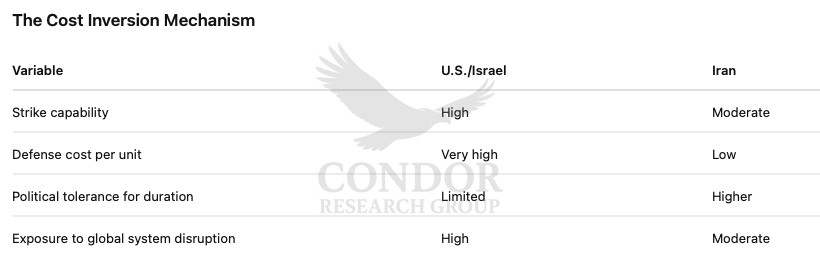
Critical Shift
The war transitions from:
Destruction contest → Cost endurance contest
In this domain:
- technological superiority matters less
- structural resilience matters more
The Proxy Multiplier
Iran’s distributed network creates:
- simultaneous pressure across theaters
- deniable escalation pathways
- persistent low-intensity conflict
This produces what has been described as a deliberate “architecture of destabilization” rather than isolated conflict events. Proxies are not extensions of Iranian power. They are independent escalation nodes aligned by incentive, not command.
CRG framing:
The war is no longer fought by Iran alone.
Victory Without Victory Conditions
Iran achieves strategic success if:
1. No decisive end-state emerges
2. U.S./Israel remain engaged across multiple fronts
3. Economic and political costs accumulate over time
4. Global systems (energy, trade, security) remain unstable
None of these require:
- territorial gain
- regime change elsewhere
- battlefield dominance
Failure Conditions (for Iran)
Iran loses only if:
- internal collapse occurs
- proxy network is dismantled
- duration is shortened into a decisive campaign
At present:
none of these conditions are met
CRG Strategic Conclusion
Iran’s strategy is not designed to:
defeat the United States or Israel
It is designed to:
make victory operationally irrelevant
Final Signal
The stronger side asks: “How do we win?”
The weaker side asks: “How do we make winning impossible?”
Iran does not need to win the war.
It only needs to ensure that no one else can.
Victory is not denied on the battlefield.
It is dissolved in the system.
Document: CRG-INT-0326/3: How Iran Wins Without Winning
Classification: Strategic Outcome Assessment
Revision Status: Final — Approved for internal CRG circulation, external academic reference, and web publication
Authorized By: Condor Research Group (CRG)
Division: Strategic Forecasting & Outcome Modeling (SFOM)
Original Draft Date: March 2026
Release Date: 24 March 2026
Version: CRG-INT-VER-A1-FINAL
Publication Note: Web release delayed; layout modified from raw analytical format